
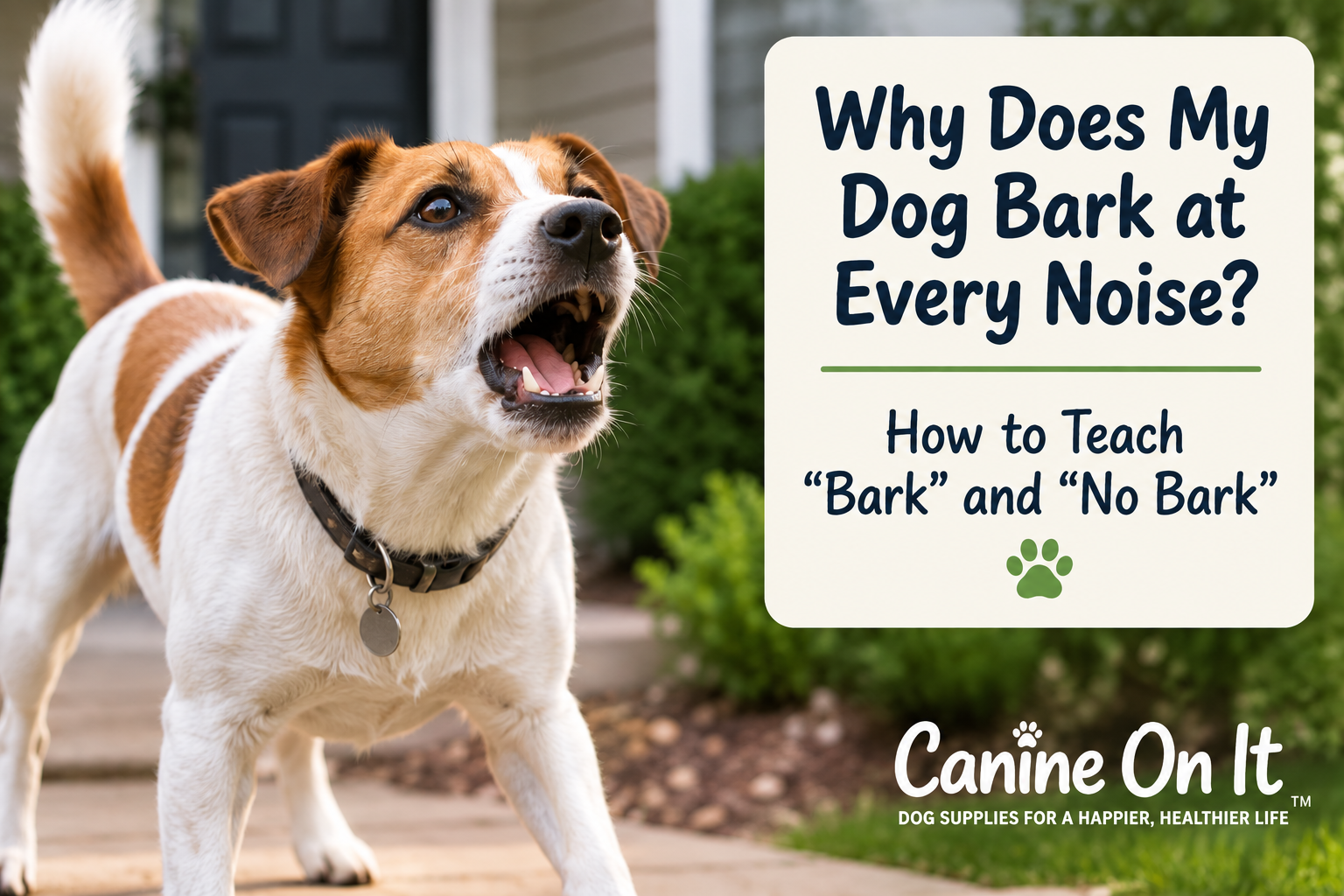
How to Teach “Bark” and “No Bark”
If your dog barks at every little noise, movement, squirrel, delivery truck—or pretty much anything that catches their attention—you may feel like you're constantly telling your dog to be quiet.
But what if, instead of simply trying to stop the barking, you taught your dog when barking is appropriate and when it's time to be quiet?
That is the approach I've used with my dogs. The goal isn't to pretend barking doesn't exist. The goal is to put the behavior under your control.
And there's an important first step: before you can tell a dog “No Bark,” I like to make sure the dog understands what “Bark” means.
Why Is Your Dog Barking?
Before you start training, it helps to understand that dogs bark for different reasons.
A dog may bark because something has caught their attention. They may be alerting you to a noise or movement, reacting to another dog, expressing excitement, seeking attention, or responding to fear or anxiety.
Sometimes excessive barking is also fueled by frustration and an abundance of built-up energy.
That's why there isn't necessarily one solution that works for every barking problem.
A good exercise routine can help give your dog an appropriate outlet for physical energy. Walks, retrieving, play, training exercises, and mental stimulation can all be useful parts of a dog's routine.
Exercise isn't a substitute for training, but a dog that has had an opportunity to use both their body and their brain may be in a better state to settle down and concentrate on you.
Once you've considered why your dog is barking, you can begin teaching them that barking is a behavior they can control.
Step 1: Put a Name on the Bark
Dogs already know how to bark. You don't necessarily have to teach them how.
Instead, you're going to capture a behavior they're already performing and give it a name.
I use the word “Bark,” but you can choose another word if you prefer.
There are two ways I've used to do this.
Take Advantage of Natural Barking
If your dog naturally barks at a noise, movement, or something that catches their attention, take advantage of that moment.
When your dog barks, say “Bark” and immediately reward the behavior.
Don't worry about getting a perfect, textbook bark.
Any form of barking can be the behavior you're labeling.
Get Your Dog Excited Through Play
You can also use play.
Some dogs will become excited enough during a favorite game to offer a bark. When they do, say “Bark” and reward them.
And remember, treats aren't the only reward.
Toys and play can be rewards too. If your dog would rather chase a ball, retrieve a toy, play tug, or interact with you than eat a treat, use what motivates that particular dog.
The important thing is that the dog begins connecting the word “Bark” with the behavior.
Repeat this process until the label is firmly established.
Eventually, you should be able to say “Bark” and have your dog understand what behavior you're asking for.
Step 2: Teach “No Bark”
This is where the first step becomes important.
I like to establish the Bark behavior first. Once the dog clearly understands what “Bark” means, I can use that understanding to teach “No Bark.”
If your dog understands “Bark” and already understands what “No” means, you can put the two together:
“No Bark.”
When your dog stops barking—even for just a moment—praise and reward immediately.
In fact, your reward will often help create that first moment of silence all by itself.
After all, it's pretty hard to bark while you're busy chewing and swallowing a treat. 😂
The important part is to recognize that brief moment of quiet and reward it.
Step 3: Start With Just a Few Seconds of Quiet
Don't expect your dog to go from barking constantly to sitting quietly for a long period the first time you say “No Bark.”
Start very small.
If your dog stays quiet for just 2 seconds, praise and reward immediately.
Then gradually work toward:
2 seconds → 5 seconds → 10 seconds → 15 seconds → 20 seconds → 30 seconds → 1 minute → longer periods
You don't have to increase the time every session.
If your dog is struggling at 5 seconds, stay there until they understand what you're asking.
Remember, training is a gradual process. Every dog learns at a different pace. Build on small successes, be consistent, and give your dog time to understand what you're asking.
You're teaching your dog that being quiet is also a behavior that earns something they want.
The reward doesn't always have to be food. If your dog is toy- or play-motivated, you can use those things as rewards as well.
Keep your training sessions short. You want your dog to understand what you're asking without becoming confused, frustrated, or losing interest.
What If Your Dog Doesn't Stop?
If you tell your dog “No Bark” and they keep barking, there are a couple of possibilities.
First, the “Bark” behavior may not be firmly established yet.
If your dog doesn't really understand what “Bark” means, “No Bark” isn't going to mean much either.
Go back and strengthen the Bark behavior.
But if your dog clearly understands “Bark” and is simply a very strong, determined barker, you may need to interrupt the barking and redirect their thoughts.
One quick verbal interruption I have used is what I call the universal mother sound:
“Ah-ah.” 😂
It's simply a quick verbal interruption that tells the dog, Nope. That's not what we're doing.
If your dog stops barking—even for one second—that's your opportunity.
Praise and reward immediately.
You're looking for the behavior you want, and when you get it, you reinforce it.
Don't Forget the Energy Outlet
Sometimes barking isn't simply about what the dog sees or hears.
A dog with a lot of built-up energy or frustration may have a harder time settling down.
That's where a good exercise and play routine can make a difference.
Give your dog appropriate ways to use that energy.
Go for a walk. Play fetch. Work on obedience. Let them retrieve. Give them opportunities to use their brain as well as their body.
Agility equipment can be a great outlet—and it can be fun for both you and your dog. Jumps, tunnels, weave poles and other obstacles give your dog something physical to do while also asking them to pay attention to you and follow your direction.
You don't have to be training for an agility competition. You can simply use age- and ability-appropriate equipment as part of play, exercise and training.
A few minutes of working through obstacles, followed by some play or retrieving, can give an energetic dog a job to do while giving you both something enjoyable to do together. A dog that has a chance to use both body and brain may find it easier to settle down afterward.
And remember, play can be a reward during training too.
Not every dog is motivated by food.
Some dogs would much rather chase a ball or play with their favorite toy. If that's what makes your dog happy, use it to your advantage.
The goal is to discover what motivates your dog and use that motivation to reinforce the behavior you want.
Training teaches control. Exercise gives energy somewhere productive to go—and having fun together makes both a lot more enjoyable.
You're Not Trying to Eliminate Barking
One thing I like about this approach is that you're not trying to make the dog forget how to bark.
You're teaching the dog that barking is something they can control.
First:
Bark → label it → reward it.
Then:
Bark on cue → understand the behavior.
Then:
No Bark → quiet → reward.
And finally:
Gradually increase the amount of time the dog remains quiet.
The dog learns that barking has a cue—and so does being quiet.
Training Takes Time
Don't get discouraged if your dog doesn't understand everything immediately.
Training is a gradual process.
Some dogs will catch on quickly. Others will need more repetition before the connection is clear.
That's okay.
You're not trying to win a contest to see how quickly you can teach your dog to be quiet. You're building a behavior that you want your dog to understand and perform reliably.
Keep the sessions short. Be consistent. Reward the behavior you want.
And remember that small successes count.
Two seconds of quiet may not seem like much, but if your dog previously couldn't stop barking long enough to take a breath, those two seconds are progress.
Build from there.
Practice Makes the Difference
As with any training, repetition matters.
Keep sessions short. Keep them positive. Use whatever motivates your individual dog, whether that's treats, toys, play, retrieving, or interaction with you.
Don't expect perfection immediately.
You're teaching your dog to recognize a behavior, understand a cue, respond to another cue, and eventually control their own response.
That's a skill.
And like any skill, it gets better with practice.
A Bark You Can Control Is Better Than a Bark You Constantly Fight
Dogs are going to bark. It's part of being a dog.
The goal isn't necessarily to silence every bark.
The goal is to teach your dog that barking is something you can control together—and that when you ask for quiet, your dog understands what you're asking.
Once your dog understands both sides of that conversation, you have something much more useful than a dog who has simply been told to shut up.
You have a dog who has learned control. 🐾
About the Author
Glenna has hands-on experience training German Shepherds in Schutzhund, earning working titles under the original Schutzhund I, II and III system. A puppy from one of her working German Shepherds also won the 9–12 month Senior Puppy class at the U.S. Sieger Show, where dogs are evaluated by German judges brought to the United States to officiate.
